


How do you convert expectation into reality on attack, or deny it on defence? One of the most important new metrics developed over the last decade in the U.S National Football League is ‘Expected Points’, or EP for short. An Expected Points [EP] model can be run before and after a play, to check whether it put the team in possession in a better situation to score points. That yields an EPA [expected points added] number.
In American Football it accounts for factors such as down, distance to go, field position, home-field advantage and time remaining in the game. Compared to a simple box-score, it has more relativity. EPA serves as a better tool of measurement for team or player performance because it understands that not all yards, touchdowns, and turnovers have the same value. All yards [or metres] are not created equal, and EPA is a granular attempt to quantify the idea of ‘momentum’, the force which wins sporting games.
The concept is in its infancy in rugby, and it is by no means perfect as a predictor of events. The Stats Perform EP index of the European Champions Cup final played between Leinster and Union Bordeaux-Bègles predicted a final scoreline of 35-31 based on events in the game, with the Dublin province overturning an 11.5-13.8 halftime deficit to win the second period by 23.4 points to 17 and emerge victorious overall.
A more orthodox analytical model also suggested Leinster were the more likely winners in the Basque country. The Irishmen
So how did the Girondins defy statistical expectation in Bilbao? They scored two turnover first-half tries from their own end, one from an interception and another from a blocked-down kick. They wound down the clock in the second period expertly by expanding the amount of ‘garbage time’; after leading 35-7 at oranges, UBB twice opted to kick for goal from penalties where they would have kicked for a 5m attacking lineout earlier. Above all, their efficiency in the red zone represented the biggest win of all for the Top 14 outfit.
Statistical success in the red zone is more important than the same in midfield. All of the carrying, ruck-building and time-of-possession stats are relatively less important than the momentum swings generated by attack and defence from the goal-line up to the edge of the 22m area. The stat which had the final say was ‘Goal-Line Denial’:

The most basic truth of the European Champions Cup final was that UBB converted their chances in the opposing 22 better than their illustrious opponents, finishing with an average 4.4 points-per-entry compared to 1.6 by Leinster. It was a doubly ironic outcome, because the Dubliners entered the match as the highest-ranked ‘goal-line deniers’ in European club competition, while the Ireland side to whom they supply so many international players had already emerged as the best in the 2026 Six Nations in the same area of the game.
Converting short-yardage situations is crucial to offensive success in the NFL – not just scoring a touchdown from few metres out, but also succeeding at 3rd-and-1, and 3rd-and 2 scenarios which allow the offence to reset with another set of four downs further upfield. But where effort in short-range situations is confined to a maximum of four plays in Gridiron, play is continuous in Rugby and the number of phases completed may enter double figures.
Both converting and denying short yardage attack creates immense physical and psychological strain. When the defence succeeds with a ‘goal-line stand’ and stops the attack within its own red zone, and especially within 10m of its own goal-line, the psychological momentum shifts hugely and the game spins on its axis.
— William Bishop (@RPvids1994) May 26, 2026
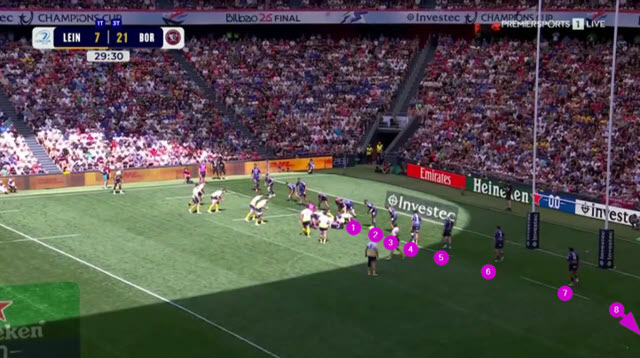
On the way out of a right-side scrum, Leinster roll around the open-side corner on six consecutive phases. Five are run by the forwards, the sixth by #12 Robbie Henshaw at 29:25 on the game clock. As long as the UBB defence is able to wrap three of its own forwards into the first three defensive slots around the ruck, there is no advantage for the attacking side.
The aim of the defence is simple: to manage the offence out to the far 15m line. As the screenshot clearly illustrates, it knows it will automatically have a superiority in numbers once the play come back towards the original touchline:
— William Bishop (@RPvids1994) May 26, 2026
On each of these switchback phases, one of the UBB backs is looking to play ‘shooter’, to rush out of the line, exploit the numerical surplus and create chaos: #9 Maxime Lucu at 29:50, #10 Matthieu Jalibert at 29:55 and 30:02, #12 Yoram Moefana on the forced fumble at 30:10. This rapidly became the theme of UBB’s goal-line denials:
— William Bishop (@RPvids1994) May 26, 2026
On the way out, stop on the gain-line and wrap three forwards around the ruck; on the way back, fly out and contest the ball. Nothing much had changed by the 76th minute of the game. Leinster came on in the same old way, and they were seen off in the same old way:
— William Bishop (@RPvids1994) May 26, 2026
On the way out, UBB are stretched after a line-break and Lucu has to fill in temporarily at the line, but on the way back the balance tilts in favour of the D. The back-side pressure initiated by Moefana’s blitzes at 75:54 and 76:00 finally yields an interception turnover at 76:14, and that is ‘game over’ for the Dubliners.
Summary
The majority of the game stats from the Champions Cup final in Bilbao – new and old – suggested that it was a contest Leinster could, and maybe should have won. They finished ahead in territory and possession, set more rucks and made more carries than their opponents. They even scored more highly on the new EP index. None of those outweighed UBB’s efficiency in the red zone, or the quality of their goal-line denials in short-yardage situations. When push came to shove, it was the Top 14 which proved its mettle.



Comments