


Cometh the hour, and there was no repletion of the 2025 mismatch. There was no better fixture to kick off the newly-minted Nations Championship than the All Blacks against Les Bleus, but it did not always look that way. Wind the clock back to July 2025, and the swirl and eddies of controversy that surrounded the selection of a France ‘B’ team to tour the shaky isles. Sky Sport’s Justin Marshall summarized the sense of outrage in New Zealand on The Breakdown rugby discussion show:
“The side the French have brought is clearly underpowered and you’re talking about an average age of 25, and an average number of caps of 9.3, this is a side that has a very little amount of experience. It’s a development team with a few senior players involved.
“It’s complete BS, the way that they’re treating this tour, the way that the French always seem to have come up with excuses to not bring their top players. I feel they disrespect the international window.”
With the Top 14 season extending all the way to a grand final in the last week of June, the players involved in it have been forced to miss out on the first match of a July international series which occurs only seven days later. In both cases, that game has happened to be France versus the All Blacks.
There was one big difference between the situation in 2025 and the scenario twelve months later. Arguably the top two clubs in European rugby, Stade Toulousain and Union Bordeaux-Bègles contested the trophy in 2025, but UBB were replaced in the Bouclier de Brennus finale by Montpellier Hérault one year later.
That enabled French head coach Fabien Galthié to select players from Europe’s champion club in his squad for the Nations Championship. Eight Girondins started the inaugural fixture against Dave Rennie’s new All Blacks, and ‘B’ or even ‘C’ standard rose steeply to B plus or even A minus with their inclusion.
The sight of French luminaries like Maxime Lucu, Matthieu Jalibert and Damian Penaud, who have lit up the game north of the equator, taking the field in Christchurch gripped the imagination of the New Zealand rugby public in a way that the relative ‘unknowns’ never could one year ago.
Even in the absence of the best winger in the world, Louis Bielle-Biarrey – who would have been slated to go up against Will Jordan – there were direct confrontations between the best in the north and the cream of the south: three Hurricanes against three Bordelais in midfield at 10-12-13. These were mano-a-mano, iron-on-iron jousts in the raw.
The game itself was officiated by one of the new breed of English ‘Prem’ referees, Bristolian Luke Pearce, and it was played out according to Prem rules. 39 exhausting minutes of ball-in-play time, 337 total rucks set with over 80% of ball delivered at lightning-quick, sub three second speed, with less than one per cent of those breakdowns subject to pilfer. One try every nine minutes. It was, to coin a phrase from the new All Blacks’ head honcho, an ‘outrageous’ tribute paid to the gods of attacking rugby.
In the context of those stats, the modern coaching buzzwords of ‘rapid recovery’ and ‘repeat involvements’ are everything, nowhere more so than on the defensive side of the ball. Leicester Tigers’ and England scrum-half Jack Van Poortvliet models his defensive contribution on the work done by one of his peers gracing the pitch at the One NZ stadium, UBB number 9 Lucu. ‘’The difference he makes for his team in defence is ridiculous"said Van Poortvliet in wide-eyed admiration.
The use of the ‘spare man’ in the backline has been a topic of debate ever since the beginning of the professional era. The scrum-half has aligned variously as the tail-gunner around end, or in the tram-lines at first phase lineout; hopping from the boot-space of one breakdown to the next in phase-play; or even dropping to full-back in red zone defence. He can defend directly behind the ruck in the old 12/1/2 defence; on the edge in a 13/2, or as a ‘libero’ blitzing out of the 14/1 rush.
Maxime Lucu’s role is to cover more real estate than any other back and plug holes in the defensive line wherever, and whenever they appear. Against the All Blacks at Te Kaha he topped the tackle charts with 15 stops. To put the scale of that contribution in perspective, the two top scrum-halves at the 2026 Six Nations, France’s Antoine Dupont and Irishman Jamison Gibson-Park, averaged six tackles per game.
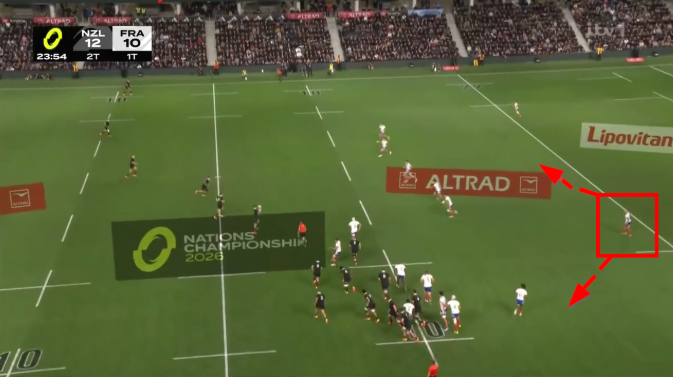
At lineout, Les Blues often started with Lucu on the blind-side wing, and dictating backfield movement in subsequent phases:
— William Bishop (@RPvids1994) July 7, 2026
Lucu starts on the left side of the French backfield, and it is his job to lead the two-man zone back to his side of the field whenever the All Blacks begin to build backline depth in that part of the pitch: working back to the left edge and attempting the ball-rip off Will Jordan at 24:20, then defending more shallow as play approaches the 22 before leading the backfield pendulum acorss for a second and decisive intervention 20 seconds later. At the finish of sequence he is the man defending wide left, taking Quinn Tupaea man-and-ball and forcing the fumble.
Lucu’s role in red zone defence was just as varied and demanding, and every bit as significant:
— William Bishop (@RPvids1994) July 7, 2026
The scrum-half starts as a short-side and boot defender, but as soon as threat develops on the opposite side of the field he is the man who must lengthen his stride and fill the lane on the cutback run by Tupaea.
The final example began with a long kick-chase by Les Bleus:
— William Bishop (@RPvids1994) July 7, 2026
In this clip, Maxime Lucu is embracing the more traditional role popularized by Aaron ‘Nugget’ Smith for the All Blacks; filling the boot-space and shadowing the attack from behind the ruck as it moves steadily across the width of the field. As soon as intent shows and the second pass is made, he is filling passing lanes after a short break and forcing another change of possession.
There was no repetition of New Zealand ‘A’ versus France ‘B’ at the Te Kaha stadium, exactly 12 months after the most controversial French squad selection in history for the tour of New Zealand. The inclusion of nine players from European champions UBB levelled the playing field completely and nudged Les Bleus to A minus, or B plus status. The teams shared 22 line-breaks between them on the day and it was nip-and-tuck all the way to the finish line.
Summary
With the dice loaded in favour of attacking spectacle, the role of the ‘spare man’ on defence came under the microscope in the context of the game’s further evolution. Maxime Lucu made a game-high 15 stops and showed just why he has become a template for other scrum-halves to follow. Jack Van Poortvliet may be just the first of many to follow in Girondin claret-and-white footsteps.



Comments