


Scott Robertson was not a bad All Blacks coach, not by a long chalk. When he was unexpectedly sacked on 15 January 2026 after a damning internal review by New Zealand Rugby, he was still a man who had won 74% of matches in charge of his country. Yes, he was coming second to ‘Rassie’ Erasmus, winning only one of the four games he contested against the Springbok Svengali, but then so is everyone else.
With a momentous ‘Greatest Rivalry’ tour sitting on the All Blacks’ doorstep in August and September this year, 74% overall and 25% against New Zealand’s greatest rivals was not good enough. The truth is that the bar has been set almost impossibly high by the combined achievements of Sir Graham Henry and Sir Steve Hansen in the 15 years between 2004 and 2019.
Between them, the pair of knights lost only 25 of the 210 games they coached with the All Blacks, and they were nominated for the World Rugby Coach of the Year soubriquet no less than13 times. 74% looks like small potatoes in comparison.
Dig a little deeper, and it was not so much Razor Robertson’s win percentage that raised the red flag, it was the playing culture behind the team on the field. A recent report by World Rugby consultant and ex-international referee Corris Thomas illustrates just how far New Zealand had drifted on the rip-tide, away from its traditional core rugby values. Of New Zealand’s performance at the 2025 Rugby Championship, Corris concluded:
“New Zealand brought an approach to the game that differed from previous years. That approach resulted in tries being scored from all parts of the field and from the various sources of possession. Tries from inside New Zealand’s own half of were not uncommon, as were tries from broken play, opposition kicks and tapped penalties.
“This year’s TRC was very different."
- New Zealand scored 86% of their tries from the set-pieces [lineout and scrum]. The other three teams averaged 56%.
- New Zealand scored only 15% of their tries from open play, the other three teams scored 48%, 43% and 41% respectively.
- New Zealand was the only team who did not score a try from a turnover or an open-field kick.
- New Zealand scored 70% of their tries from possession gained in their opponents’ 22m zone – the highest proportion of any team.
- New Zealand scored only two tries from inside their own half – the lowest proportion of any side.”
In other words, the All Blacks had adopted a style of play which was close to the opposite of the methods which had won them two consecutive World Cups, in a golden era when they won over 85% of the matches they played. The sense of historical continuity had been lost, and the legacy had been misplaced.
The appointment of ex-Chiefs, Glasgow and Wallabies head coach Dave Rennie marks a return to those values. He worked with the third of the three wise men, Sir Wayne Smith at the Chiefs, and the duo won two back-to-back Super Rugby titles in 2012 and 2013, by making the most of the talent at their disposal and evolving the meaning of counter-attack:
“If we defended really well and we got a turnover, we were pretty clinical…. The ball’s kicked to you as many times in a game as you have scrums and lineouts put together, so there are plans around counter which have been effective for us – [even if] this year we had the least amount of possession in the comp.”
When he first moved to Scotland, Rennie was still riffing on the same theme. “I want us to have a confidence that if it’s ‘on’, we launch from anywhere. From 95 [metres] out, it’s sometimes easier than five out.”
Although ‘the Professor’ is now committed to life in the Land of the Rising Sun, Rennie has shrewdly reconnected with two others from the golden era of New Zealand professional rugby, by appointing 79-year old Henry and Gilbert Enoka to key roles in his support team. Ted will function as an extra selector and Enoka will beat the drum of cultural improvement on a daily basis, reinforcing the need for mental toughness at the pointy end of games:
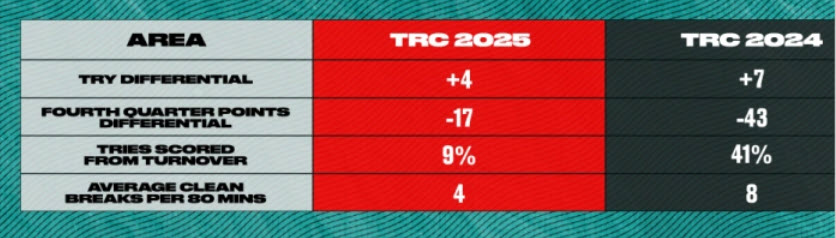
Those are the two critical areas of improvement in a nutshell. At two successive Rugby Championships in 2024 and 2025, Razor’s All Blacks rolled in at combined minus 60-point differential in the final 20 minutes of games, while their ability to score from turnover scenarios dropped by 32% from one season to the next.
When Rennie looks for the Kiwi Super Rugby franchise most likely to fill both of those needs, his attention may well be drawn towards the Cake Tin in Wellington. Clark Laidlaw’s Hurricanes had scored the most tries from turnover 29 after 15 rounds of competition, six more than Rennie’s beloved Chiefs in second spot. Moreover, they had by far the best points differential in the fourth quarter – a massive plus 60 points score in the last 20’, 21 points than the Brumbies in second place.
An early kick-off return from the Canes 47-24 drubbing of the Blues illustrated the confidence Rennie wants ‘to launch from anywhere, from 95 metres out, it’s sometimes easier than five out.’
— William Bishop (@RPvids1994) May 30, 2026
— William Bishop (@RPvids1994) May 30, 2026
The key to the score is the interplay between #10 Ruben Love and #12 Jordie Barrett at first and second five-eighth, and there is a strong case for the pair to be lobbed straight into Dave Rennie’s first New Zealand selection. Between them, the dynamic duo has six important interventions in the 50 seconds or so the sequence lasts, and they provide the connective tissue needed to fan the flames of the attack: they can split to either side of the first ruck [9:25 with Jordie right and Ruben left], and they are quite comfortable with roles reversed on the same side of the field, with Jordie at first receiver [9:50] and Ruben at second.
Summary
The All Blacks lost some of their quintessential identity in the Razor era, with Dave Rennie they are good chance to reclaim it, just in time for the inaugural ‘Greatest Rivalry’ tour of the Republic in August and September. He has already recruited Sir Graham Henry and Gilbert Enoka, two of the stalwarts of the golden era, to his support staff.
He will climb into his silver DeLorean, and travel back to the future to rediscover the Kiwi penchant for counter-attack and obdurate mental fortitude in the fourth quarter. To rephrase Doctor Emmett Brown from the movie, ‘if you’re gonna build a time machine into a rugby team, why not do it with some style?’



Comments