


The big question in French rugby revolves around the top two clubs in the domestic league, Stade Toulousain and Union Bordeaux-Bègles. Toulouse is the only club side with six stars on its fabled rouge-et-noir jersey, having won the European Champions Cup on six occasions. UBB is the new kid on the block, having won the last two finals in 2025 and 2026. One team has already carved out its name in rugby history and wants to enhance the legacy, the other is looking to write it in indelible ink.
The way the two clubs go about the business of attacking with ball in hand is very different, and that is what has generated so much creative friction in the national selection process. Where Toulouse features a player at number 9 who is often described as the ‘best player in the world’, and possibly the premier rugby athlete of any era in Antoine Dupont, the champion of the UBB attack is #10 Matthieu Jalibert, who was one of the statistical stars in Opta’s European Team of the Season:
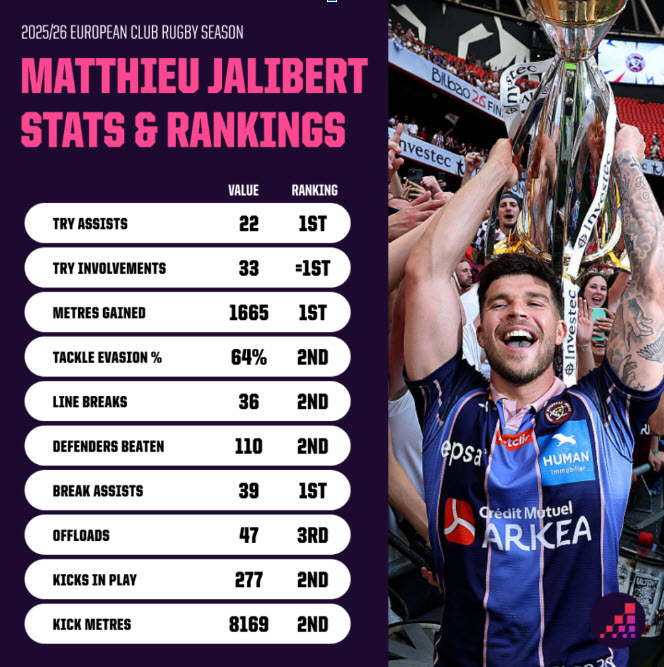
In the Top 14, Dupont averages 14 runs per game in 2025-2026 compared to only five by his international rival Maxime Lucu on the Atlantic Coast. While all four halves at both clubs – Dupont, Lucu, Jalibert and Romain Ntamack – are an automatic part of the France national squad at peak strength, the balance on attack is fundamentally different:

Where UBB feature movement of the ball outside first receiver on 26% of occasions – on the first page of Opta’s European stats summary – Toulouse only shift it beyond 10 21% of the time, halfway down the second sheet.
UBB’s attack coach is a native of County Clare in Ireland, and his name is Noel McNamara. Before the European Champions Cup final against Leinster, he talked about the challenge of putting the Bordeaux gameplan on the map against a Jacques Nienaber-coached, South African style rush defence.
“It’s a particular challenge. There is a bit of fool’s gold on the edges. They are very compact, and you can’t go and find that [space out wide] too soon, so it is about going direct. We have some players who are very good at that.
“It is not a defence that we come up against particularly often, and I can tell you that that really motivated the players. They were excited with the opportunity to attack against that. The best players are motivated by challenges.
“When we did put speed in the game – Leinster have been very good at slowing down the ruck, the average ruck speed is over four seconds against them – I would imagine that [in the game] it was a little bit quicker and that was a big factor for us. Obviously when there is no ruck, that is even better.
“The goal is to be all-terrain. The goal is to have the ability to score tries and win games in whatever way is required, and I think we talk about it sometimes, about ‘medicine’ for our game.”
The challenge for McNamara was how to get to the edge off his playmaker at #10, Matthieu Jalibert, when the air-supply to space out wide is initially suffocated by the blitz. The keynotes are there in black-and-white: penetration before width, quick ruck ball, or offload with no ruck at all. Be flexible, be all-terrain.
Les Rouge et Noirs take the anti-blitz theory to an extreme. They always look to achieve penetration off #9 first. In their recent Top 14 semi-final against Parisians Racing 92, they were still playing for a ‘vertical axis’ break with their opponent down to 13 men on two yellow cards:
— William Bishop (@RPvids1994) June 25, 2026
Antoine Dupont both starts and finishes a move that never looks likely to produce a score anywhere but straight between the posts.
Romain Ntamack is a bona fide international-quality outside-half. But the most interesting aspect of the game was the way in which breaks and scores out wide were manufactured directly off number 9, without the assistance of the traditional playmaking nous associated with the man in the position outside him:
— William Bishop (@RPvids1994) June 25, 2026
— William Bishop (@RPvids1994) June 25, 2026
In both clips, Dupont uses Ntamack as a decoy runner in order to connect directly with one of his outside backs – #13 Pierre-Louis Barassi in the first instance at 5:34 and Teddy Thomas at 5:45 on the cross-kick to the right edge, then Thomas for a second time at 22:00. In all three scenarios Ntamack is a ‘live’ option on the pass and in one he is actively calling for the ball, but he is ignored. The traditional notion of ‘function’ and ‘creativity’ has been turned on its head in the relationship between #9 and #10. The scrum-half is no longer there to serve the man outside him.
Even on those occasions when Dupont was not present, the same principle remained valid:
— William Bishop (@RPvids1994) June 25, 2026
After a long run by youngster Kalvin Gourgues down the left, acting scrum-half #11 Matthis Lebel has only thought on his mind, and that is keeping his feet away from the tackle and beating the interior defence to the goal-line.
Summary
On the eve of the inaugural Nations Championship, national supremo Fabien Galthié has an interesting choice to make in the French style of play on attack. The best team in Europe is Union Bordeaux-Bègles and they play off the little magician Matthieu Jalibert at 10. The best team in France is Stade Toulousain and they play off all-world scrum-half Antoine Dupont at 9. How will he merge the two options? Can they be fused successfully? For the first game against Dave Rennie’s All Blacks at least, it will be UBB all the way, with Lucu and Jalibert in harness and Toulouse’s petit général recovering from his exertions in the Top 14 final against Montpellier Hérault.



Comments