


Ten years ago, it was very much ‘the day of the jackal’ at the breakdown, with outstanding crop of number 7’s like George Smith, Richie McCaw, Michael Hooper, Sean O’Brien and Sam Warburton always looking to pilfer ball at the tackle. They all tended to play the same blue-riband position, at open-side flanker.
Measuring the efficiency of those players in their specific area of expertise was not just a matter of calculating how many times they stole the ball. That was the start-point, but it had to be ‘fact-checked’ against other related categories which were equally important.
How often did their actions slow the ball down past the critical four-second ruck threshold? How many times were they penalized for offences committed in the action of ‘pilfering’? These, and other categories gave a far more comprehensive picture of the impact of a ‘jackaler’.
Nowadays, jackaling is spread across the pitch and the number 7 is no longer alone. Frequently, he is not even the foremost pilferer for his team. The following short table tracks the number of pilfers won against the number of penalties given up to round 7 of Super Rugby Pacific 2025:
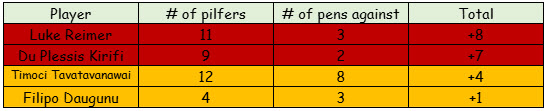
The top two exponents are both dedicated number 7’s, for the Brumbies and the Hurricanes respectively, while the latter two are backs [for the Highlanders and the Reds] operating from either the centre or wing positions.
In terms of jackaling efficiency, <b.there is work to be done in the space of balance – getting on-ball strongly, but also with the required discipline:
“If you have come down on the ground [on one knee], you’ve got release the ball” says Nic Berry in the first instance. In the second, Daugunu never circles around to enter the ruck from his own side. The Queenslander finally got his technique right in the 63th minute:
Summary
The ball is exposed, Daugunu is on his feet and entering from behind the tackle, so on this occasion he is rewarded by Berry. But the three-stage process underlines the need for jackaling efficiency: knowing when to compete, and knowing when to stop, or pull out of the contest. Strength allied to intelligence is the answer.
Watch Wallabies’ Assistant Coach Laurie Fisher’s excellent series on the defensive breakdown



Comments