


‘Oom’ Paul Roos’ famous telegram to the 1937 Springboks contained only three words: ‘skrum, skrum, skrum’. Those legendary Boks remain the only South African side to have won a series away from home in New Zealand, and that one word distils much of the double world champions’ attitude to the game. If you cannot dominate and win a penalty at one scrum, try, and try again.
It also creates a fissure in the refereeing of the game – a split between officials who want the ball to emerge from the set-piece and restart the game, and those who are happier for the scrum to end in a sanction. It has been a major bone of contention in the phoney war between the two head coaches Dave Rennie and ‘Rassie’ Erasmus off the field. Symbolically it represents a major fork in the road for the future of the game as a whole.
Senior All Blacks assistant coach Neil Barnes put his finger on many of the underlying issues in the aftermath of the third Test in Johannesburg:
““You can’t hide from it. Their set piece is pretty damn dominant, and they get a gravy train of penalties from it.
“I’m not going to say they’re all legit, but at the end of the day, we’ve got to change the perception for the officials as well, so we get a fair rub of the green, but yeah, we’ve got to be solution-based here.
“So yeah, not all on it. We’re not going to beat ourselves up too much, but at the moment it stinks. We’re coming second to this crew, and we tried bloody hard to get the right result for our country and it hurts.
“If you look at our ball, there’s hardly a penalty. The ball comes out and plays, [but] the mindset over here is your set-pieces are there to create penalties to get yourself down the other end of the field.”
Veteran ex-Saracens and Western Province hooker Schalk Brits recalls a long conversation with Rassie when the new Springbok supremo first took over in 2018, bookmarking the importance of the scrum to the national psyche.
When Brits protested the new policy: “I said, ‘we can’t scrum for a penalty at every scrum’. Rassie looked at me and replied, ‘Why not?’”
That is the short-hand for the South African view of the set-piece. It is a shortcut to win penalties; either exit with ease from your own end, or pump the ball deep into the opponent’s half with lineout advantage to come. The scrum culture begins at the level below, with the four South African franchises in the URC. Three of the quartet are the top scrummaging sides in the league:
URC scrum penalty analysis 2025-26
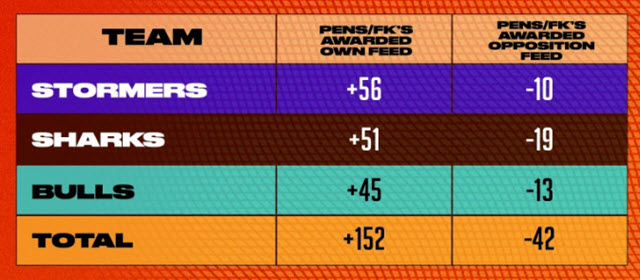
The three South African teams win the vast majority of penalties on their own feed, but when their opponents put the ball into the scrum, the penalty count levels out, to the point of a reversal of the expected ‘dominance’. Even in the November 2025 encounter between the Springboks and Ireland, which was about as one-sided as it gets at scrum-time, the Bokke won all their penalties, and drew both yellow cards on the Irish front row on their own feed. Ireland won three of their own put-ins cleanly, and even squeezed a free-kick out of South Africa at the fourth.
With the feeding side winning an average of 94% of their own ball at the recent Nations Championship, all the cards are stacked in favour of the feeding team, and something of the playing charter’s stated desire for ‘a balance of contestability and continuity’ has been lost at set-piece. The looming crisis at scrum-time was in full evidence on a super Saturday in Soweto which featured two games; first between the Springbok Women and the Black Ferns, with the men’s version between the Springboks and All Blacks following hot on its heels at the Calabash.
Between them, the Springbok Men and Women won 10 turnover penalties or free-kicks at the scrum, and seven of those occurred on their own feed. A table of the scrum penalty distribution over the first three Tests in the RGR series reinforces the same question: if the South African scrum is a universally-dominant force, why can’t it exert the same penalty pressure on the opposing feed that it does on its own ball?
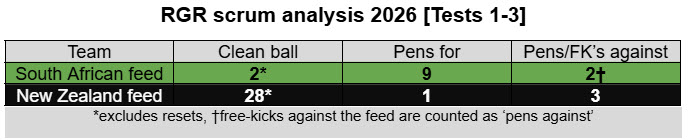
On their own feed, the All Blacks have had little problem securing possession, winning 91% of their own put-in and using their scrum ball in the first Test to score two tries directly from the set-piece, while drawing a yellow card for a deliberate knock-on by the defensive scrum-half in the action of stopping a third. New Zealand did not lose any of its own scrum feeds to penalty or free-kick after the 55th minute of the first game at Ellis Park.
By way of contrast, the Springboks are not coached to use the ball from scrum without winning a penalty from it first. 85% of their scrums have not been completed, with 82% of those penalties awarded to South Africa, culminating in the award of a penalty try scrum at the third Test in Soweto. The ‘scrum ending in sanction’ has become an art form in the Republic.
The other question raised by Neil Barnes was around refereeing perception, and a third table illustrates a clear difference in attitude between referees from south and north of the equator:
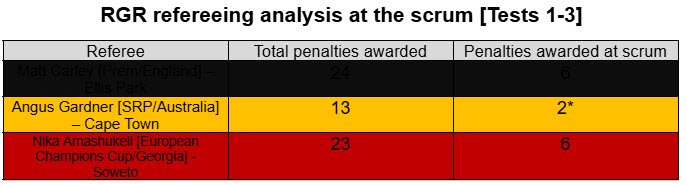
The Australian referee from Super Rugby Pacific, Angus Gardner, awarded at least 10 penalties fewer than either the Prem’s Matt Carley or Georgian Nika Amashukeli overall, and he reduced the number of sanctions [two penalties and one free-kick*] awarded at scrum-time by half. Scrums completed at a rate of 80% in the second Test where he officiated, compared to 67% at Ellis Park and a lowly 57% in Soweto.
Refereeing culture and background clearly make a huge difference to the officiating of the scrum. Over four resets and two whole minutes at a scrum just after half-time, Gus Gardner resolutely refused to bow to the pressure to blow his whistle for a penalty, insisting that the initial placement of the hooker’s brake foot be respected. He is in a minority.
Summary
The future role of the scrum in rugby has reached a crossroads. Is the set-piece there just to provide a ‘gravy-train of penalties’ as Neil Barnes observed, or should it be an opportunity ‘to restart play safely and fairly’ as World Rugby’s lawbook demands? At present the scrum is not an even contest for the ball, and it generates too little of the clean stuff. In the second part, we will look at how the bias towards the feeding team, and differences in refereeing perception have shaped the current RGR series.



Comments